
You finish your last job of the morning, return to the van and check your phone.
There are three missed calls. Two came from the same number, several minutes apart. Another caller left a voicemail, but you cannot listen to it until you are somewhere quieter.
You know the calls happened. What you do not yet know is why those people called, whether somebody has already responded or what needs to happen next.
That is the limit of a recent-calls list. It can preserve a number and a time, but it does not preserve the story of the enquiry.
A useful missed-call record fills that gap. It does not need to contain every detail of the conversation, and it certainly does not need to become an extra administrative project. It only needs four groups of information: who called and when, what they need, what should happen next, and where the enquiry currently stands.
Get those four things right and you can return to a record later without having to reconstruct the entire situation from memory.
1. Who called and when
Start with the information you already have.
Your phone’s call history will usually show the caller’s number and the date and time of the call. If the number belongs to an existing contact, you may also have a name. If it does not, leave the name blank until you speak to the caller.
There is no need to interrupt a treatment, climb down a ladder or stop halfway through a customer conversation to make a detailed note. At the next safe pause, create a minimal record from the call history:
Number ending 4821 — called Tuesday at 10:40 — return call by 13:00.
That is enough to prevent the call from becoming an unidentified number buried among the rest of the day’s notifications.
The caller’s name can be added after you reach them. If somebody else is responsible for returning the call, add that person’s name now as well. This matters in a small team, where “someone will call them” can easily mean that two people call—or nobody does.
For illustration, imagine the number ending 4821 belongs to a potential customer called Lena Morris. At the time of the missed call, you do not know that. Your initial record can simply say “name unknown”. Once you have spoken to her, you update it.
This article focuses on what belongs in that record. If you need the broader response process, start with what to do after missing a customer call.
Once you know who called, the next question is the one your phone cannot answer.
2. What the caller needs
A name and number tell you who to contact. They do not tell you why the call matters.
After speaking to the caller or listening to their message, add a short, specific description of what they need. The note should make sense to somebody who was not part of the conversation—including you, several hours later.
Compare these two entries:
Asked about service.Needs an estimate for end-of-tenancy cleaning next Thursday.
The first confirms that a conversation happened. The second tells you what the enquiry is about and gives you something useful to act on.
The right level of detail varies by business. An electrician might record that a customer has intermittent power in the kitchen and wants a visit this week. A dog groomer might note that the caller is looking for a first appointment for a medium-sized dog. A landscaper might record that the customer wants an estimate for hedge trimming before the end of the month.
You are not trying to write a transcript. Capture the details that affect the response: the service required, the rough scope and any relevant timing or location information.
For Lena’s enquiry, the note might now read:
Lena Morris — needs an estimate for end-of-tenancy cleaning of a two-bedroom flat next Thursday.
That tells you considerably more than “cleaning enquiry”, without collecting unnecessary personal information.
There is a useful test here: if another person picked up the record, would they understand what the caller is asking for? If not, the description probably needs one more useful detail.
Knowing what the caller wants is only half the job, though. A clear enquiry can still sit untouched if nobody turns it into an action.
3. What should happen next—and when
“Follow up later” sounds like a plan, but it is missing three things: the action, the owner and the deadline.
A complete next step answers:
- What needs to be done?
- Who is responsible?
- When should it happen?
Depending on the enquiry, that might mean returning the call, sending an estimate, checking the diary, confirming availability, requesting photographs or arranging a site visit.
For example:
Aisha to send the estimate by 16:00 today.
That is much easier to manage than:
Send estimate.
If you work alone, adding your own name to every record may be unnecessary. The deadline still matters. “Send appointment options before the end of today” gives you a clear point at which the task is either complete or overdue.
In a team, always include the person responsible. Do not rely on everybody remembering a conversation held across a reception desk or in the van between jobs.
Sometimes the next action belongs to the customer. Perhaps they need to send photographs, confirm an address or choose between two appointment times. Record that too, along with when you will check again:
Waiting for customer to send photographs by Wednesday. Review Thursday morning if nothing has arrived.
This prevents “waiting for the customer” from becoming an indefinite holding area.
Lena’s record might now contain:
Aisha to prepare and send the estimate by 16:00 today.
There is now a clear job with a clear owner and deadline. But the record is not finished forever. As soon as something happens, its current position needs to change.
4. The current outcome or status
The next action tells you what should happen. The status tells you where the enquiry stands now.
Useful statuses might include:
- Not yet contacted
- Callback attempted
- Waiting for customer
- Estimate sent
- Booked
- Not proceeding
Choose wording that makes sense in your business and use it consistently. You do not need a long list of finely separated stages. You need enough clarity to distinguish an enquiry that still needs attention from one that has been completed.
A status should change as the enquiry moves forward. Lena’s record could progress like this:
Not yet contactedCallback completed — estimate requiredEstimate sent — waiting for customer until FridayBooked for Thursday
Or, if she decides not to go ahead:
Not proceeding — no further action
The final outcome matters because an old record that still says “estimate sent” leaves an unanswered question. Did the customer accept it? Did they decline? Are you supposed to contact them again?
A current status prevents that uncertainty. It also stops you from returning a call that another employee has already handled or chasing a customer who has already made a decision.
What a complete record looks like
Put the four information groups together and the result remains compact:
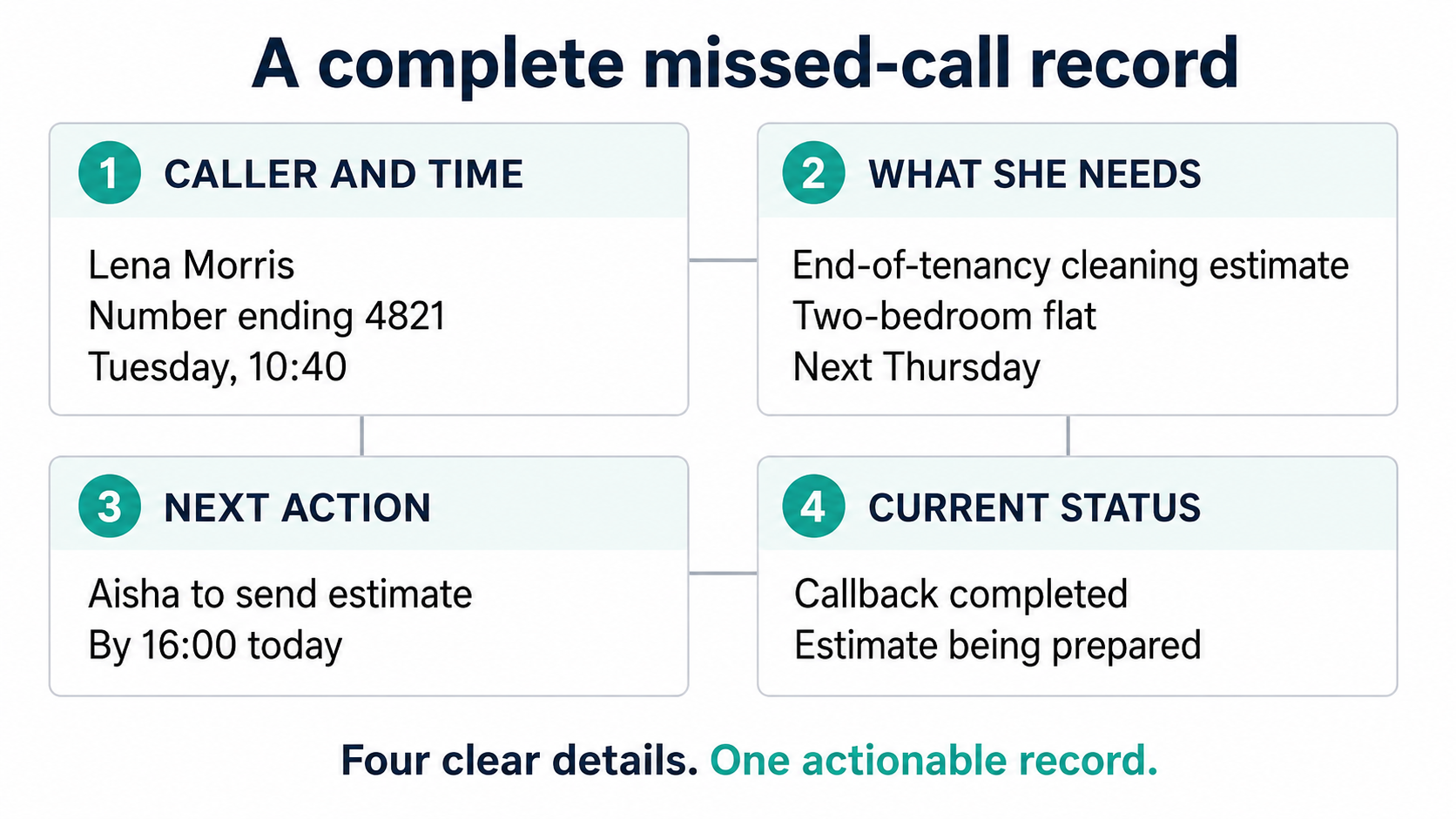
Caller and time: Lena Morris, number ending 4821. Called Tuesday at 10:40.What she needs: Estimate for end-of-tenancy cleaning of a two-bedroom flat next Thursday.Next action: Aisha to send the estimate by 16:00 today.Current status: Callback completed; estimate being prepared.
Later, only the parts that have changed need to be updated:
Current status: Estimate sent; waiting for Lena until Friday at 12:00.
This is a fictional example, but the same structure works whether the caller needs a boiler repair, a beauty appointment, a garden clearance or help with a faulty appliance.
The record is brief because every line has a job. It gives you enough context to continue the enquiry without forcing you to reread an entire conversation.
A brief review keeps records useful
Even a good record can become stale if nobody looks at it again.
For a solo business, a brief end-of-day review may be enough. A team might assign the check to the person handling reception, bookings or follow-up that day.
Look through the open records and ask:
- Is anybody still waiting for a first response?
- Does every open enquiry have a clear next action?
- Is there a date or deadline attached to that action?
- Has anything marked “waiting for customer” received a reply?
- Can any completed enquiry be given a final outcome?
This is not meant to become a lengthy meeting or a complicated reporting exercise. The aim is simply to spot loose ends while the details are still easy to recover.
If an entry has no next action, give it one. If a deadline has passed, decide whether to follow up or close the record. If the customer has replied, update the status so the old information does not mislead whoever checks it next.
A useful record should tell the story at a glance
The best missed-call record is not the one containing the most information. It is the one you can understand without guesswork.
Who called? What did they need? What happens next, and when? Has the enquiry been resolved?
If your record answers those four questions, you can put the phone down and return to the work in front of you—knowing the call has somewhere dependable to go.
← Back to all articles