Following up after a quote becomes uncomfortable when the contact is improvised. There is no agreed timing, no clear reason for getting in touch and no point at which the enquiry will be closed.
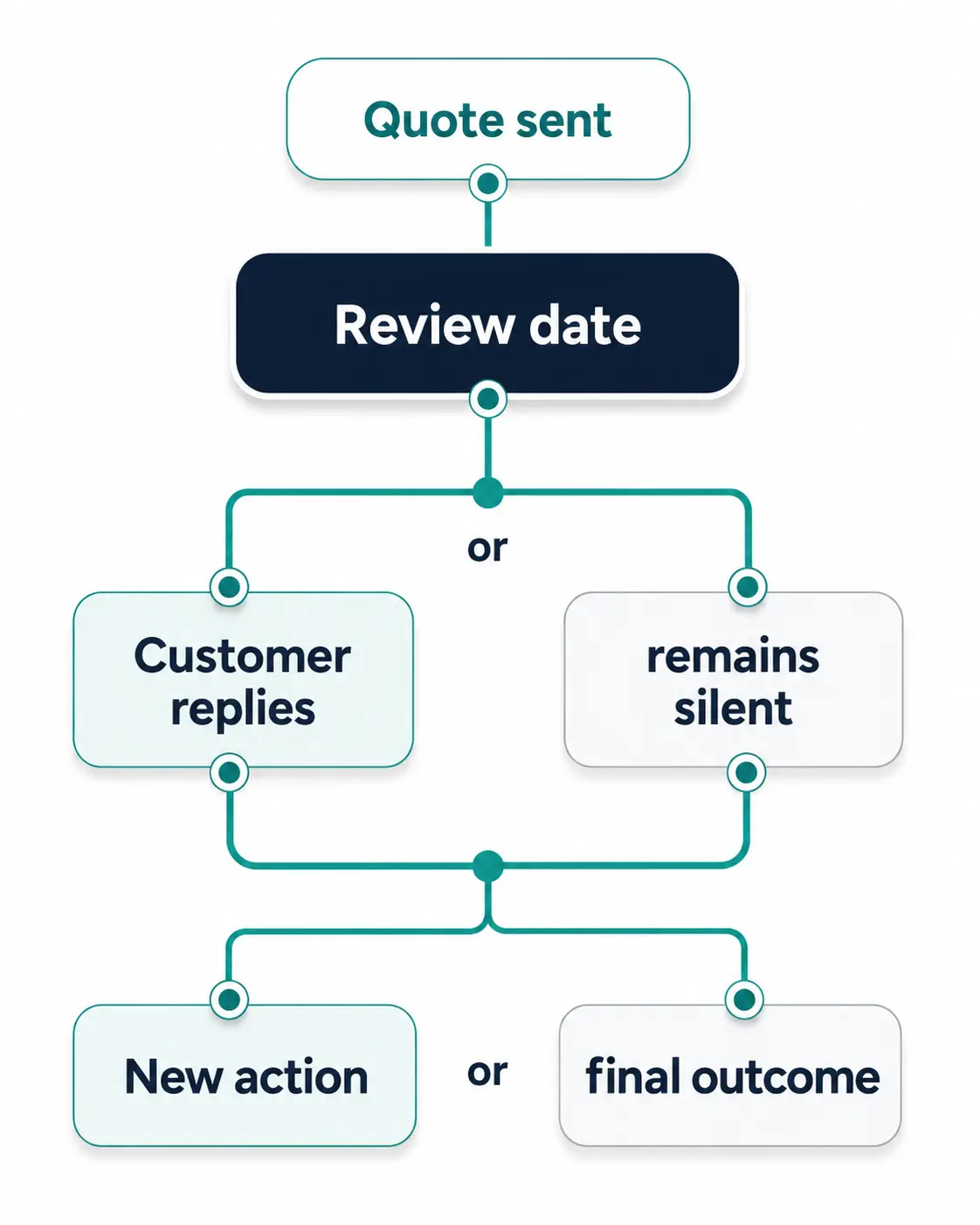
A simple process removes much of that uncertainty. When you send the quote, decide when you will review it, why you might contact the customer and what you will record afterwards.
That is the practical difference between considerate follow-up and repeated chasing.
The quote itself is only one step. Until the customer books, declines, postpones or stops responding after an appropriate final contact, the enquiry still needs somewhere to go.
Agree the next step while the conversation is fresh
The easiest follow-up to make is one the customer expects.
When possible, ask about their decision window while you are discussing the work. A simple question is enough:
“When are you hoping to make a decision?”
The answer gives you context. Someone arranging an urgent repair may decide sooner than a customer gathering estimates for work planned later in the year.
You can then explain what will happen next:
“I’ll send the estimate this afternoon. If I haven’t heard from you, I’ll check in on Thursday in case you have any questions.”
That short exchange makes the later contact expected and useful. You are not appearing unexpectedly to ask for a decision; you are carrying out the next step you already described.
Sometimes you will not have that conversation. The request may arrive by message, or another person may gather the details. In that case, set a review date when you send the quote. “Follow up next week” is easy to forget. “Review on Thursday” can be acted on.
There is no single interval that suits every business or every estimate. Use the customer’s stated timing, the complexity of the work, any date-sensitive availability and the time reasonably needed to review the information. The aim is not to discover a perfect number of days. It is to prevent the estimate from entering an open-ended waiting period.
Keep the quote inside the enquiry process
A sent folder confirms that an email left your account. It does not show whether the customer received it, understood it or decided what to do.
Once you send a quote, update the enquiry record with enough information to manage the next step:
- the customer and service required;
- the date the quote was sent;
- any timing or decision window discussed;
- the next review or follow-up date;
- the preferred contact method;
- the current status;
- the person responsible, if you work in a team.
You do not need to copy the whole estimate into the record. Keep the detailed document where it belongs. The enquiry record only needs to tell you what is happening now and what should happen next.
For illustration, a compact entry might read:
Service: Bathroom extractor-fan replacementQuote sent: TuesdayCustomer timing: Hopes to arrange the work this monthNext action: Check receipt by text on FridayStatus: Quote sent—first follow-up scheduled
This is not a customer case. It is an example of the minimum information needed to return to a quote without reconstructing the situation from messages and memory.
If your wider enquiry record is still taking shape, the SBS article on the four details every missed-call record needs explains how to capture the customer, their need, the next action and the current status. A quote record applies that same discipline at a later stage.
Give each follow-up one useful purpose
“Just following up” often feels awkward because it does not tell the customer what the contact is for.
Choose one useful purpose before you write. You might want to:
- confirm that the quote arrived;
- answer a question about the scope;
- check whether the customer’s timing has changed;
- clarify an option or exclusion;
- arrange the next conversation;
- ask whether the enquiry should remain open.
A first follow-up might say:
“Hello [Name], I’m checking that the estimate for [service] reached you. If you have any questions about the scope or timing, I’m happy to clarify them.”
If the customer gave you a decision date, you can refer to it:
“Hello [Name], when we spoke, you were hoping to decide by Friday. Is there anything in the estimate you would like me to explain before then?”
These messages give the customer an easy way to reply without assuming they are ready to book. They also avoid false urgency. If your availability has genuinely changed, say so plainly. If it has not, do not manufacture a deadline to provoke a response.
Replace every reply with a new next action
A response moves the enquiry forward, but it does not always close it.
Imagine the customer says, “We’re still interested, but we need to speak to the landlord first.” The old next action is now obsolete. Replace it with the customer’s current position and a dated review point:
Status: Waiting for customer to speak to landlordNext action: Review next Wednesday if no update arrives
Without that date, “waiting for customer” can become a permanent holding area.
Use the same discipline for other replies. If the customer asks a question, record who will answer it and when. If they request a revised scope, record that a new quote is required instead of leaving the old one marked simply as sent. If they postpone the work, record when another contact would be appropriate, provided they have agreed to it. If they accept, move the enquiry into the booking process. If they decline, record the outcome and close it.
The record should reflect the customer’s current position, not merely the last task your business completed.
Decide what silence will mean
Silence is not a reliable outcome. A customer who has not replied may have chosen another provider. They may also be busy, waiting for someone else or planning to return to the work later.
You do not need to guess why. Decide how many contacts are appropriate for the enquiry and what the final contact will do. That decision may vary with the type of work, the earlier conversation and any timing the customer gave you.
A final message can close the immediate loop without making a permanent assumption:
“Hello [Name], I haven’t heard back about the estimate for [service], so I’ll close the enquiry on my side for now. If you still need the work later, you’re welcome to get back in touch and I can confirm the current availability.”
After that message, record a factual outcome such as “closed—no response”. Do not invent a reason for the silence. If the customer asks you not to contact them again, respect the request and close the record immediately.
Useful final outcomes might include booked, declined, postponed, replaced by a revised quote, outside the services offered or closed after no response. Keep the list small and define the labels clearly enough that everyone uses them in the same way.
Review open quotes in one place
You should not have to search through emails and messages to remember which estimates need attention.
Keep one view of open quotes. For a solo business, that might be a page in a planner or a spreadsheet filtered by next-action date. A small team might use a shared list with an owner for each next action. Useful statuses could include quote being prepared, follow-up scheduled, follow-up due, waiting for customer, revision required, booked, declined and closed—no response.
Review the list by next-action date, not by whichever customer comes to mind first. The SBS guide to keeping track of customer follow-ups without a CRM shows how to fit that review into a manageable daily routine.
A manual list can suit one person or a small team with a manageable number of enquiries. A CRM or job-management platform may be more suitable when several people need live assignment, automated reminders, integrations or more detailed reporting. The point is not to stay manual forever. It is to use a system your business can maintain at its current level of complexity.
A sent quote still needs somewhere to go
The difficult part of quote follow-up is rarely writing one polite message. It is remembering which quotes remain open, knowing why you are contacting the customer and changing the record when the situation moves.
Give every sent quote a review date. Give every follow-up a purpose. Give every reply a new action or a final outcome.
That is how an estimate stops being a document sitting in an inbox and becomes part of an enquiry process you can manage.
← Back to all articles