You open a list of enquiries from the last few weeks and find several that never became bookings.
One says “went elsewhere”. Another says “no reply”. A third has a note that reads “probably too expensive”. Two simply stop after an estimate was sent.
The list appears to contain reasons. In reality, it contains a mixture of customer decisions, unfinished follow-up, assumptions and missing information.
That makes it difficult to learn anything dependable.
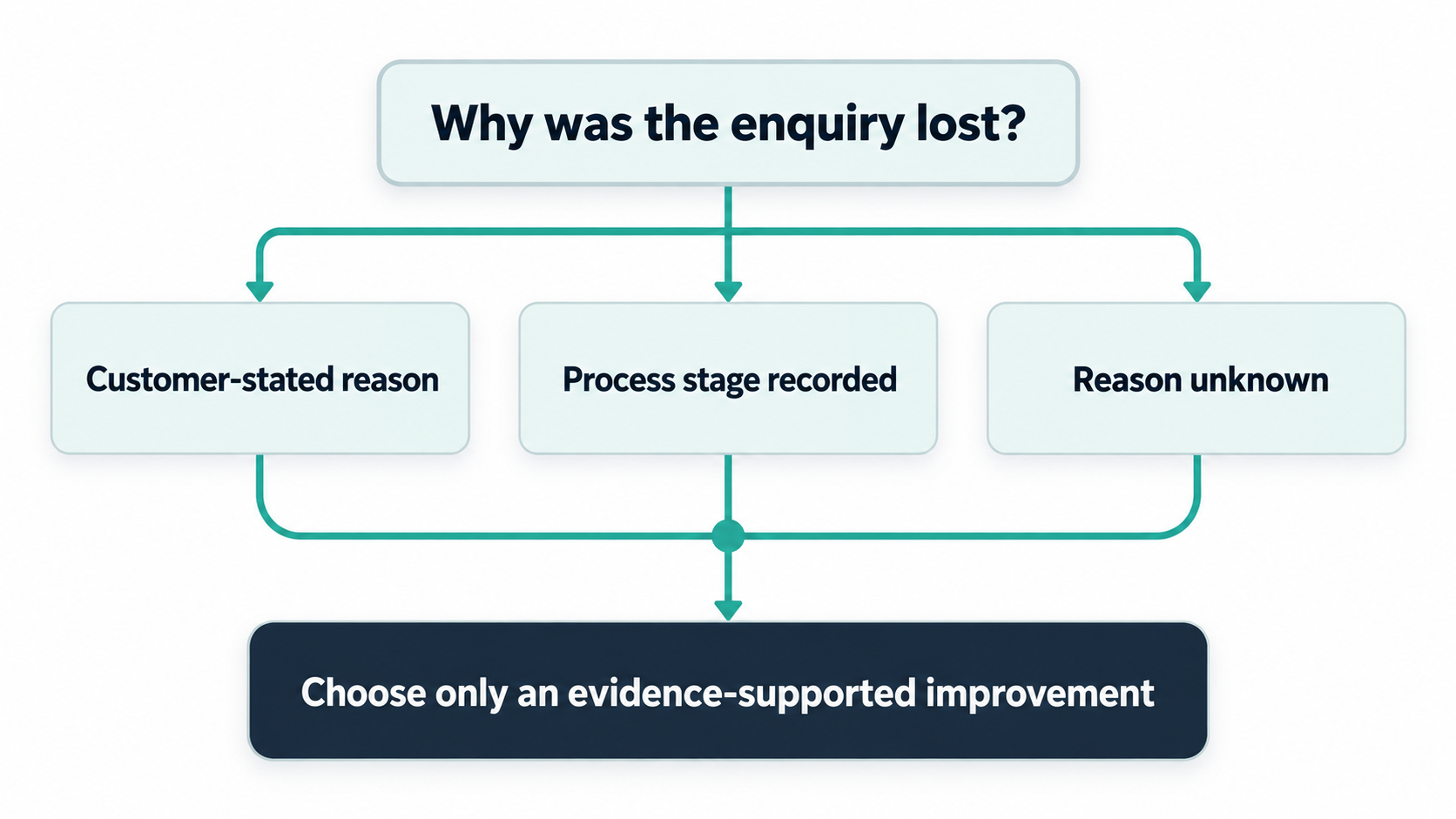
A useful lost-lead review does not begin by asking, “Why did we lose these customers?” It begins with three narrower questions: What was the customer’s last known position? Where did the enquiry process stop? Which reason, if any, did the customer actually give?
The stage tells you where the enquiry stopped. The reason tells you why it stopped. If the customer never gave a reason, the honest answer is unknown.
Those distinctions may not produce a dramatic explanation. They will give you something better: a fair view of what happened, what remains unknown and which part of your process is worth improving.
Decide when an enquiry is genuinely closed
You cannot review lost leads properly while old enquiries are still sitting in vague statuses such as “waiting”, “estimate sent” or “follow up”.
First decide whether each enquiry is still open.
An enquiry may be closed because the customer:
- booked the work;
- declined and gave a reason;
- declined without giving a reason;
- postponed the work;
- chose another provider;
- no longer needed the service;
- stopped responding after an appropriate final contact.
It may also close because your business could not provide the service, cover the location or offer a suitable time.
These are different outcomes. “Did not book” is true for most of them, but it is too broad to guide a useful review.
Be careful with postponed enquiries. If the customer has agreed that you may contact them later, the record may need a future review point rather than a lost status. If no further action has been agreed, close the current enquiry factually instead of keeping it active forever.
The SBS guide to following up after sending a quote explains how to give an unanswered estimate a review date and a clear final contact. That same discipline helps you decide when a quote has moved from open work into a completed outcome.
Record the last point you can verify
Once the enquiry is closed, identify the last verified point in its story.
For example:
- Customer asked for a cleaning estimate. Estimate sent. No response after final contact.
- Customer requested a Saturday appointment. No suitable Saturday slot was available.
- Customer received two service options and said they would postpone the work until winter.
- Customer declined and said the proposed timing was too late.
Each line records what is known. It does not stretch the facts into a larger conclusion.
This matters because the final status alone can hide an operational gap. “Closed—no response” might describe an enquiry that received two thoughtful contacts. It might also describe an enquiry that sat untouched for nine days before anyone replied.
The customer outcome is the same. The business process is not.
Record the last completed business step as well as the final outcome. Depending on the enquiry, that step might be:
- first response sent;
- callback completed;
- information requested from the customer;
- availability checked;
- estimate prepared;
- estimate sent;
- follow-up attempted;
- appointment options offered.
You are not building a transcript. You are locating the point where the enquiry stopped moving.
Separate the reason from the stage
The stage where an enquiry ended and the reason it ended are not the same thing.
Suppose a customer stopped responding after an estimate was sent. The stage is clear: estimate sent, no recorded response. The reason is unknown unless the customer told you.
It may be tempting to mark the lead as “price”. Perhaps the estimate felt high to you, or the customer asked about cost early in the conversation. Neither proves that price caused the decision.
They may have delayed the work, chosen a different approach, found somebody with earlier availability or simply stopped prioritising the job. You do not need to fill the gap with a theory.
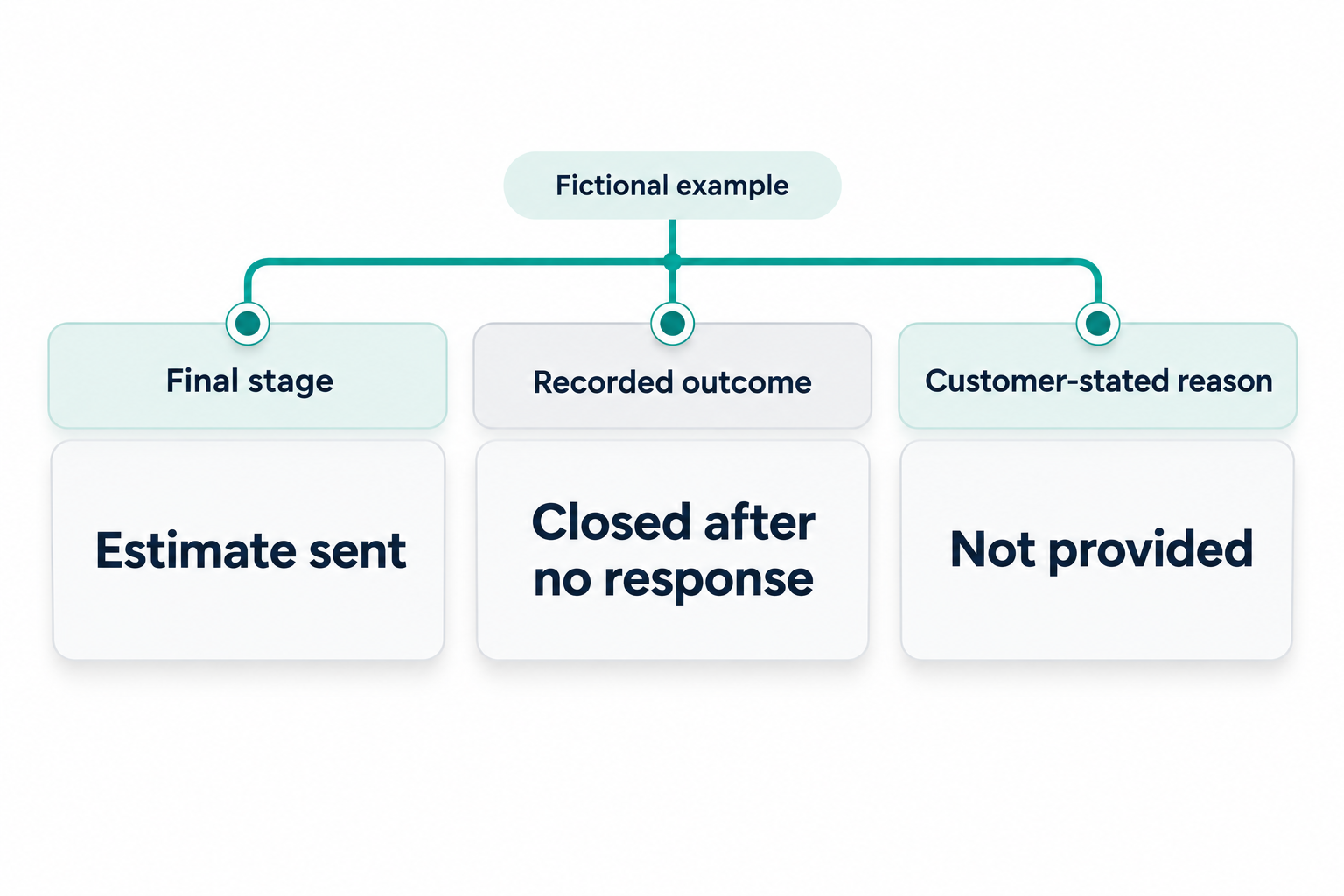
Use wording that preserves the difference:
- Final stage: Estimate sent
- Recorded outcome: Closed after no response
- Customer-stated reason: Not provided
If the customer says, “We found someone who can come this week,” you have a stated reason related to availability. If they say, “The price is higher than we expected,” you can record price or budget in their own terms. If they only disappear, keep the reason unknown.
“Unknown” is not failed recordkeeping when the customer did not provide an answer. It is an honest boundary around the evidence you have.
Use a short set of reasons people can apply consistently
When a customer does give a reason, use a small, defined list rather than creating a new label for every enquiry.
A service business might use categories such as:
- timing or availability;
- price or budget;
- scope or service mismatch;
- location outside service area;
- customer postponed;
- chose another provider;
- no longer needed;
- reason not provided;
- no response after final contact.
Your list should reflect the decisions your business actually encounters. Keep enough detail to distinguish useful patterns, but not so much that two people record the same situation under different labels.
Notice that “no response after final contact” describes an outcome, not a motive. It can still be useful because it may be the most accurate information available.
If you work with a small team, agree what each label means. One person may use “timing” when the customer wanted an earlier appointment; another may use it whenever the customer said “not now”. A short definition beside each category will make later comparisons more trustworthy.
Look for patterns in the process, not a culprit
A lost-lead review is not a search for who made a mistake. It is a way to see whether the same friction appears more than once.
Review a manageable group of closed enquiries from a recent period and ask:
- At which stage did they most often stop?
- How many have a customer-stated reason, and how many remain unknown?
- Were promised responses, estimates and follow-ups completed when agreed?
- Did availability, service area or scope create repeated mismatches?
- Are the records detailed enough to understand what happened?
Do not force a conclusion from one unusual case. A single customer may choose another provider for reasons that have nothing to do with your process. Look for repeated, specific signals.
For instance, several enquiries may end because the requested dates are unavailable. That does not automatically mean you need more capacity. You may need clearer availability information earlier in the conversation, a waiting-list option or a better way to offer alternatives.
If many records end with an unknown reason, the first improvement may not be a sales script. It may be a clearer final-status habit so the team stops replacing missing information with guesses.
Turn one finding into one practical change
The review becomes useful when it changes a small part of the working process.
Choose one finding that is supported by the records and decide what you will do differently. For example:
- If estimates often sit without a review date, set that date when the estimate is sent.
- If enquiries repeatedly fall outside the service area, make coverage clearer before detailed quoting begins.
- If appointment timing is a common stated reason, ask about the customer’s required date earlier.
- If team records stop after “called back”, require a next action and current status after every conversation.
- If reason labels are inconsistent, reduce the list and define each option.
Keep the change specific enough to test. “Improve follow-up” is difficult to observe. “Every sent estimate receives a review date before the record is closed” is clear.
Then check the next review period. Did the process change happen? Are the records clearer? Has the same gap appeared again?
The purpose is not to promise that every enquiry will become a booking. Some customers will postpone, decline or choose another business. The purpose is to stop preventable process gaps from being hidden inside a general pile of “lost leads”.
Do not turn every lost lead into a permanent follow-up
Reviewing a lost enquiry does not automatically authorise another contact.
Some customers may welcome a later check-in because they explicitly postponed the work and agreed to hear from you. Others have declined, chosen another provider, asked not to be contacted or simply reached the end of the follow-up process you explained.
Respect the recorded outcome and any applicable communication or privacy requirements. Do not create an endless reactivation list merely because the business now has better notes.
The lesson from a closed enquiry may belong in your process, not in another message to the customer.
A lost lead should leave a clearer process behind
You will not know why every customer failed to book. Trying to make every blank field sound certain only makes the review less reliable.
Close enquiries with a factual outcome. Record the last completed stage. Keep customer-stated reasons separate from assumptions. Then look for the small number of patterns your business can actually change.
A lost lead cannot always be recovered. It can still help you make the next enquiry easier to manage.
← Back to all articles